Language-Based AI Modeling of Five-Factor Model Traits and Personality Pathology from Life Narrative Interviews
Jul 16, 2025·, ,,,,·
1 min read
,,,,·
1 min read
Joshua R. Oltmanns
Ritik Khandelwal
Zerui "Jerry" Ma
Jocelyn Brickman
Tu Do
Rasiq Hussain
Mehak Gupta
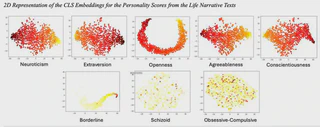 2D Representation of the CLS Embeddings for the Personality Scores of the Life Narrative Texts
Abstract
Personality disorders (PDs) are at a crossroads in classification and conceptualization. Advances in artificial intelligence (AI) and natural language processing hold promise for clarifying PD models and improving research methodology, understanding, and ultimately clinical treatment. This study uses language for modeling personality and personality pathology. A representative community sample of N = 1,409 older adults across the St. Louis region (33% Black, 65% white, 2% other) completed a life narrative interview from which language was used to train and test language models of personality based on scores from the NEO-Personality Inventory-Revised (NEO-PI-R) and the Structured Interview for DSM-IV Personality (SIDP-IV). Criteria measures were used for multi-method construct validation of the language models including self-report measures of physical functioning and depressive symptoms and informant-report measures of personality, general health status, and social functioning. Language from life narrative interviews was modeled to identify personality through fine-tuning the parameters of the RoBERTa language model, BERTopic topic modeling, and Linguistic Inquiry and Word Count. Fine-tuned RoBERTa models predicted personality scores in testing data above r = .40. Language in life narrative interviews supports the semantic similarity of the five-factor model (FFM) personality trait domains more than DSM personality disorder categories, for which only borderline pathology had support. The language-based FFM scores were supported by multi-method criteria correlations including informant-report personality scores in the testing data. Findings support dimensional conceptualization of personality and demonstrate the promise of language-based AI to refine conceptual frameworks of PD and provide automatic personality assessment and prediction in research and clinical practice.
Type
Publication
Check out the PDF of this article.
